How to Lose Weight With No Time to Exercise
Here is the straight answer: you can lose weight with no time to exercise, because fat loss is driven by a calorie deficit, and the deficit is set in the kitchen, not the gym. Fix the food and the weight comes off, no workout required.
If you searched how to lose weight with no time to exercise, you have probably been told the opposite your whole life: that you need an hour of cardio you do not have, and that if you cannot find it, you are stuck. I was overweight for years myself, so I will not sell you that. You are not stuck. You have just been pointed at the wrong lever.
The lever that actually moves fat is the calorie deficit, and the deficit is built almost entirely by what you eat. Exercise helps your health in real ways, but it is not the thing that gets the weight off. Once you understand that, the no-time problem mostly disappears, because eating well takes no extra hour in your day.
Why you can lose weight without exercise
Fat loss comes down to one thing: taking in less energy than you spend, day after day. That gap is the calorie deficit. Almost all of it is decided on the eating side, not the burning side, and the math is brutally one-sided in food's favor.
A typical gym session burns a few hundred calories. One muffin, one large coffee drink, or a second helping at dinner cancels it in seconds. It is far easier to not eat 500 calories than to go and burn 500 calories, and it takes no time at all. That is why people who train hard but eat without a plan often do not lose weight, and why the whole "I'll just work it off" idea quietly fails.
So the honest reframe is this: you do not need exercise to lose fat. You need a deficit, and the deficit is food-led. If that idea is new, the mechanics are laid out plainly in calories in versus calories out, explained. Exercise is a fine bonus on top. It is not the engine.
What to do instead of workouts
If the food sets the deficit, then the move is to design your food so the deficit happens on its own, without cooking marathons or hours you do not have. Three plain rules carry most of the result.
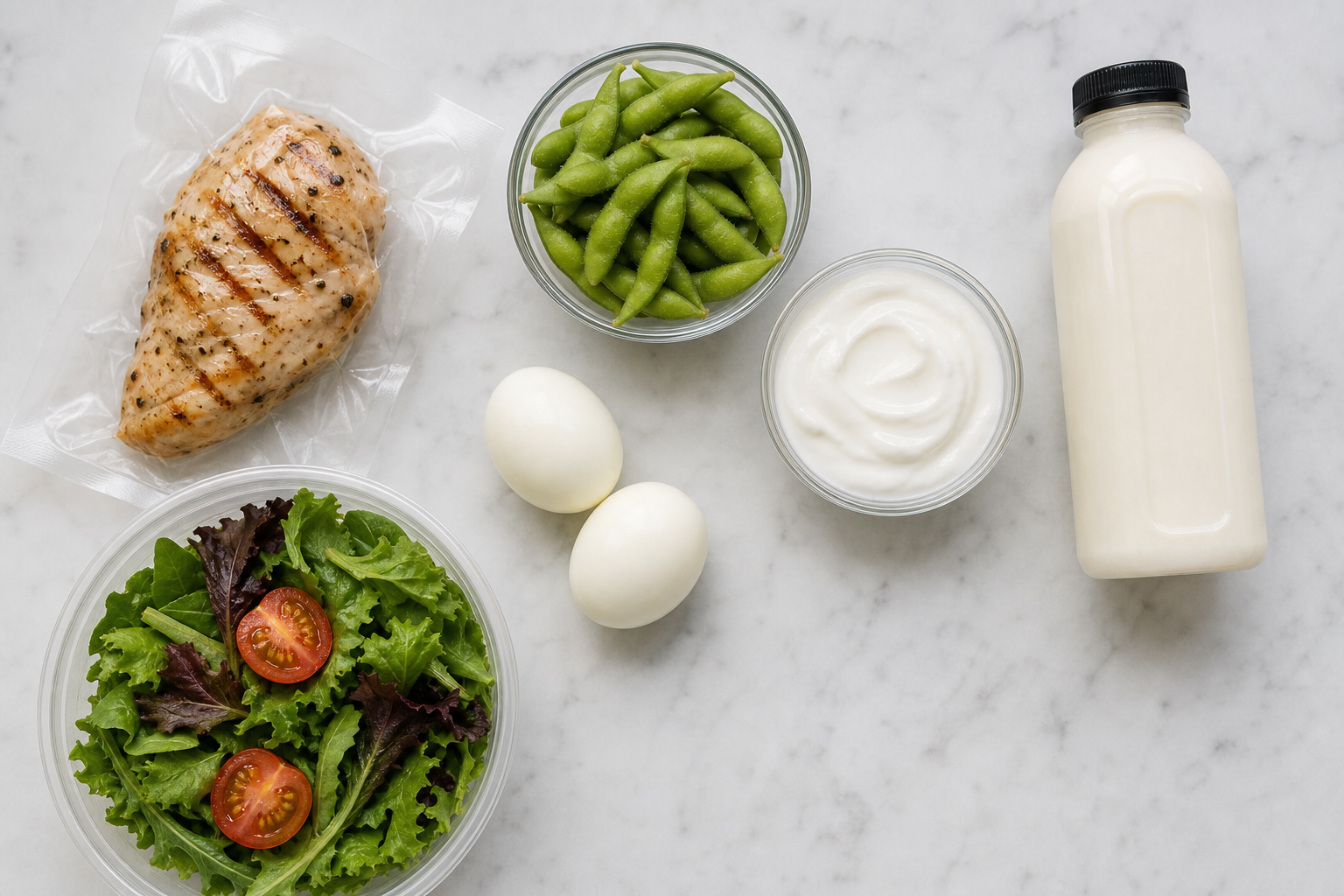
- Protein first. Build every meal around a clear protein source: skyr, quark, cottage cheese, a rotisserie chicken, tuna, jerky, a protein shake. Protein keeps you full longer and protects your muscle while you lose fat, so you eat less without white-knuckling through hunger.
- No-cook by default. You do not need recipes. You need a short list of grab-and-go items that are high in protein and low in calories, ready to assemble in two minutes. Cooking is a tax on time and willpower, and you can skip it.
- Fewer decisions. Pick five or six meals you actually like and rotate them. Every fresh decision is a chance to drift, and a tired, busy person drifts toward whatever is fast and calorie-dense. Lock the choices and the drift stops.
None of this asks for an hour you do not have. It asks you to choose well once, then repeat. That is the entire mechanism behind the 711 protocol: a fixed set of convenience-store and supermarket items that put you in a deficit without a kitchen.
NEAT and steps: the cheap bonus, not the engine
There is one kind of movement worth adding, and it is the kind that costs you no extra time: walking. A lot of your daily burn comes from everyday activity, not formal exercise. Researchers call it NEAT, non-exercise activity thermogenesis. It is the energy you spend standing, walking, doing errands, and moving through a normal day.
Steps are the easiest way to nudge that number up, and the best part is they hide inside things you already do. Take calls on your feet. Park further away. Get off one stop early. Walk while you think. None of it requires a gym slot or a change of clothes.
But be clear about the scale. A solid day of walking adds maybe 200 to 400 calories of burn, which is real and worth having, yet it is also one snack you did not plan for. Steps widen the gap a little. They do not set it. Treat walking as a cheap bonus on top of the food, not as the thing doing the work. If you want the full honest picture on this, see walking for weight loss and, on the flip side, why running on its own is not an effective weight-loss strategy.
Make the deficit the default, not a willpower fight
Here is the part most advice skips. The reason busy people fail at weight loss is almost never laziness or weak discipline. It is that they are forced to make the right choice fresh, over and over, while tired, rushed, and surrounded by easy calories. That is a fight you lose eventually, no matter how motivated you are.
The fix is to stop relying on willpower and let your environment do the deciding. Set it up once so the right choice is the easy one and the wrong one takes effort.
- Stock the deficit at home. Keep the high-protein, low-calorie items in the fridge and the snack foods out of the house. You eat what is within reach. Make what is within reach the right thing.
- Pre-decide the day. Know your three or four go-to meals before you are hungry. Hunger plus an open choice is how plans fall apart.
- Remove the friction from good, add it to bad. Protein ready to grab, treats two errands away. You will not fight your environment, so let it pull you the right way.
When the deficit is built into your surroundings, you stop spending willpower on every meal. The weight comes off in the background. If it has stalled even though you are trying, the cause is usually a hidden gap between what you think you eat and what you actually eat, which is exactly what why you are not losing weight in a calorie deficit walks through.
An honest note: exercise still has value
I am not telling you exercise is pointless. It is good for your heart, your blood sugar, your mood, your sleep, and for holding on to muscle while you lose fat. If you can move, you should, and any movement you enjoy is worth keeping.
But that is a different question from how to lose weight. For fat loss specifically, exercise is not required, and pretending you need an hour you do not have is what keeps people from ever starting. Get the food right first. Add the movement you can fit, when you can fit it. Do not wait on the gym to begin, because the part that actually decides your weight is already in your hands, three times a day, in what you choose to eat.
You have no time. That is exactly the point.
The 711 Diet is the physician-built system: which exact convenience-store and supermarket products to grab, in which combo, at which calorie tier. No cooking, no tracking, no workout you do not have time for.
Get The 711 Diet Protocol →Can you really lose weight without exercise?
Yes. Fat loss is driven by a calorie deficit, and the deficit is set far more by what you eat than by what you burn in a workout. Exercise is good for your health, but it is not required to lose fat. If your food puts you in a deficit, the weight comes off whether or not you ever set foot in a gym.
How do I lose weight if I have no time to exercise?
Stop trying to out-train your schedule and fix the food instead. Make a small number of high-protein, low-effort choices the default, so the deficit happens without you deciding fresh every meal. Add cheap movement where it already fits, like walking during calls. The food does the work, the steps are a bonus.
Is diet or exercise more important for weight loss?
For losing fat, diet wins by a wide margin. A few hundred calories from a workout are easily erased by one snack you did not plan. It is far easier to not eat 500 calories than to burn them. Exercise matters for health, mood, and keeping muscle, but the deficit itself is built in the kitchen.