How Much Weight Can You Lose in a Month?
A realistic pace is about 1-2 lb (0.5-1 kg) per week, which means about 4-8 lb (2-4 kg) in a month for most people. The first week can look faster because lower carbs, less salty food, and smaller portions drop water weight before body fat catches up.
The honest answer is boring, which is why it works. You do not need a brutal detox, a secret supplement, or a personality transplant. You need a calorie deficit you can repeat, enough protein to protect muscle, enough movement to keep the engine warm, and meals that do not make your life feel smaller.
That is the ohne-Verzicht part: less decision-making, not less living. A month is long enough to see real change, but short enough that water, sodium, digestion, menstrual cycle, travel, and restaurant meals can make the scale look dramatic or unfair. So use the range, then use the calculator below to make it personal.
Set your current weight, goal, unit, and weekly pace. The calculator estimates weeks to goal, target date, and monthly loss.
A good default is 0.5-0.75% of body weight per week. Push toward 1% only if hunger, training, sleep, and mood still stay normal.
How much weight is healthy to lose in a month?
For most people, healthy monthly weight loss is 4-8 lb (2-4 kg). If you are smaller, already lean, stressed, or dieting while traveling, the lower end may be the smart end. If you start at a higher body weight, the same percentage of body weight can produce a larger number on the scale.
A useful rule is 0.5-1% of body weight per week. At 200 lb, that is 1-2 lb per week. At 140 lb, it is 0.7-1.4 lb per week. This is why fixed promises are sloppy: two people can do the same plan perfectly and lose different amounts.
| Current weight | Good weekly pace | Good monthly pace |
|---|---|---|
| 140 lb / 64 kg | 0.7-1.4 lb | 3-6 lb / 1.5-3 kg |
| 180 lb / 82 kg | 0.9-1.8 lb | 4-8 lb / 2-4 kg |
| 240 lb / 109 kg | 1.2-2.4 lb | 5-10 lb / 2.5-5 kg |
The scale is not a pure fat meter. Eat fewer carbs for three days and you can drop water. Have ramen, alcohol, and a late flight and you can "gain" several pounds without gaining fat. Judge the trend across 2-4 weeks, not one dramatic morning.
How much can you lose in a month with Ozempic / GLP-1?
With Ozempic or another GLP-1, one month is usually too short to judge the full effect. Many people lose a few pounds in the first month, but the early dose is often a ramp, appetite reduction is not identical for everyone, and the bigger published results are measured over months.
The simple expectation: GLP-1s can make the deficit easier because hunger and food noise often fall. They do not delete the basics. Protein still matters, resistance training still matters, and a low-food month with low protein can leave you smaller but softer. If you are using a GLP-1 while living out of convenience stores or hotels, start with the protein list in the best protein for GLP-1 guide and the GLP-1 7-Eleven Thailand guide.
Be especially careful with the first-month comparison game. Someone who starts heavier, drops alcohol, cuts salty takeout, and responds strongly to the medication can lose much faster than someone who is already active and only has 10-15 lb to lose. That does not mean one person is doing it right and the other is failing.
How much weight can you lose in 3 months?
At the standard 1-2 lb per week pace, three months is roughly 12-24 lb (6-12 kg). In percentage terms, 5-10% of body weight in 3 months is a strong result. At 200 lb, that is 10-20 lb. At 80 kg, that is 4-8 kg.
Three months is where habits beat hacks. A very aggressive first month can work on paper, then collapse when weekends, travel, social meals, and fatigue return. A calmer plan that you can repeat for 12 weeks usually wins: protein at every meal, mostly zero-calorie drinks, a daily step floor, and two or three strength sessions per week.
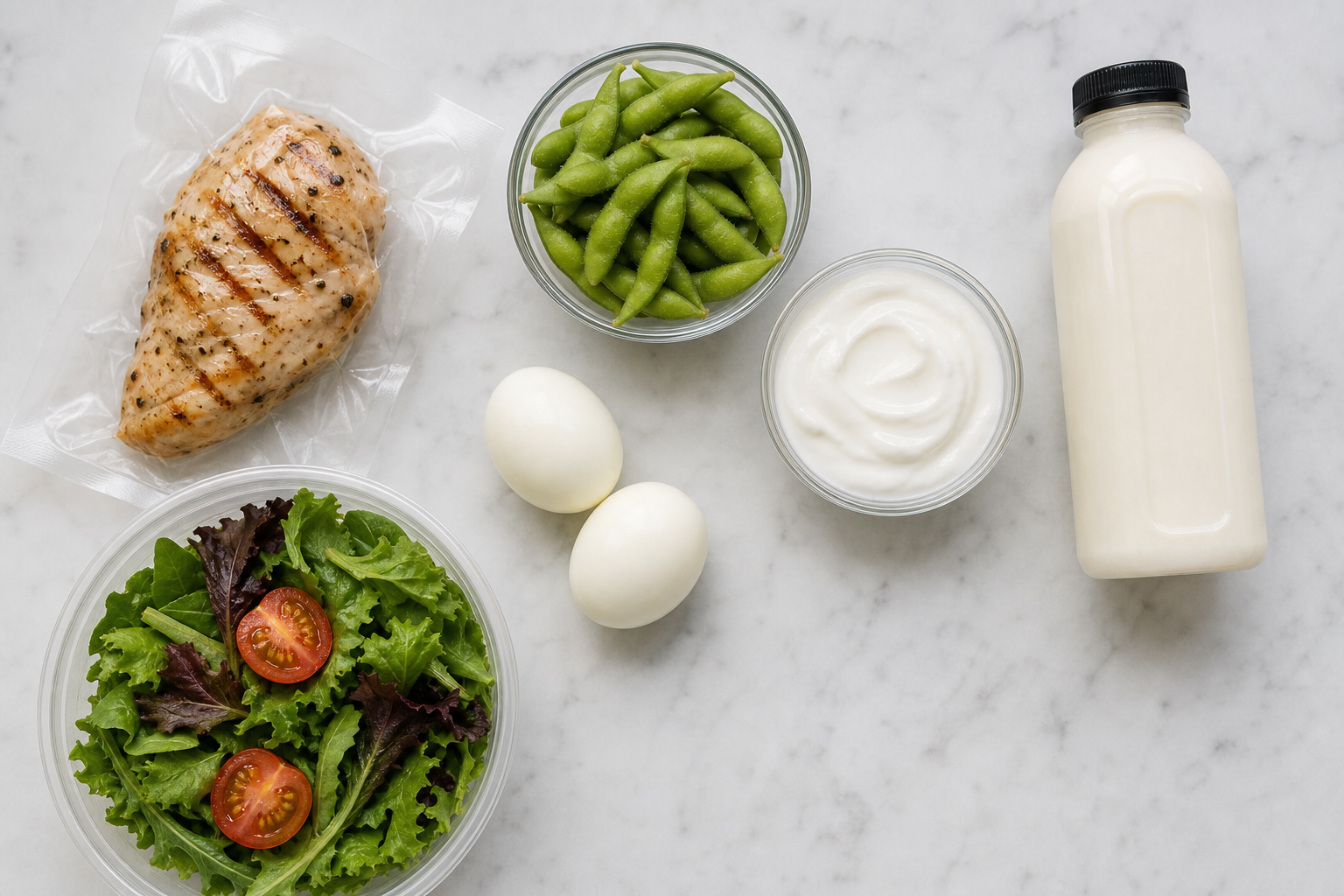
If your diet has to survive airports, Bangkok heat, hotel rooms, or late work nights, build around boring defaults. For Thailand, the easiest setup is grilled chicken, eggs, yogurt, tuna, edamame, and high-protein milk from 7-Eleven Thailand high-protein foods. For snacks, use the healthy 7-Eleven snacks guide instead of trying to freestyle when hungry.
What makes the number faster or slower?
The biggest driver is the size of the calorie deficit, but the scale has many moving parts. Starting weight changes the absolute number. A 1% weekly loss is 2.5 lb for a 250 lb person and 1.3 lb for a 130 lb person. Both are the same rate.
- Protein: Higher protein makes dieting easier and protects lean mass.
- Steps: Daily walking quietly raises expenditure without making hunger explode.
- Strength training: The goal is not to burn huge calories; it is to keep muscle while fat comes off.
- Sleep: Bad sleep raises cravings and makes normal portions feel less satisfying.
- Alcohol: It adds calories, worsens sleep, and makes late food decisions worse.
- Sodium and carbs: These can swing water weight by several pounds in either direction.
- Consistency: Five decent days and two chaotic days often average to maintenance.
Do not aim for the fastest number you can force. Aim for the fastest number you can repeat without your food life becoming weird. The best month is the one that sets up the next month.
Stop deciding what to eat.
The 711 Diet is the physician-built system: which exact 7-Eleven products to grab, in which combo, at which calorie tier. No cooking, no tracking, no willpower.
Get The 711 Diet Protocol →FAQ
How much weight is healthy to lose in a month?
About 4-8 lb (2-4 kg) is realistic for many people. Smaller bodies may lose less, larger bodies may lose more, and the first week may include extra water weight.
How much can you lose in a month with Ozempic / GLP-1?
Often a few pounds in month one, with bigger changes showing over several months. The medication can reduce appetite, but protein, movement, and sane portions still decide the quality of the result.
How much weight can you lose in 3 months?
Roughly 12-24 lb (6-12 kg) at 1-2 lb per week. A 5-10% body-weight loss in 3 months is a strong practical benchmark.
What makes the number faster or slower?
Starting weight, calorie deficit, protein, steps, strength training, sleep, alcohol, carbs, sodium, medications, and weekend consistency all matter.
Can you lose 20 pounds in a month?
It can happen on the scale, especially at a higher starting weight, but it is not the normal fat-loss target. Most people do better chasing a repeatable 4-8 lb month.
Numbers are practical estimates for adults. Food choices, body size, training, sleep, travel, and water weight can move the scale faster or slower than the trend.